
Peak is coming and you are three vans and four drivers short. Somewhere two ZIP codes away, another operation like yours has both sitting idle. That is the whole idea.
Free to open. You pay only when you buy, and nothing when you list.
2021 Ford F-59 P1000
Marietta, GA · 84,210 mi · Shelved
$450/wk
2020 Isuzu NPR-HD P700
Forest Park, GA · 61,880 mi · Unbranded
$390/wk
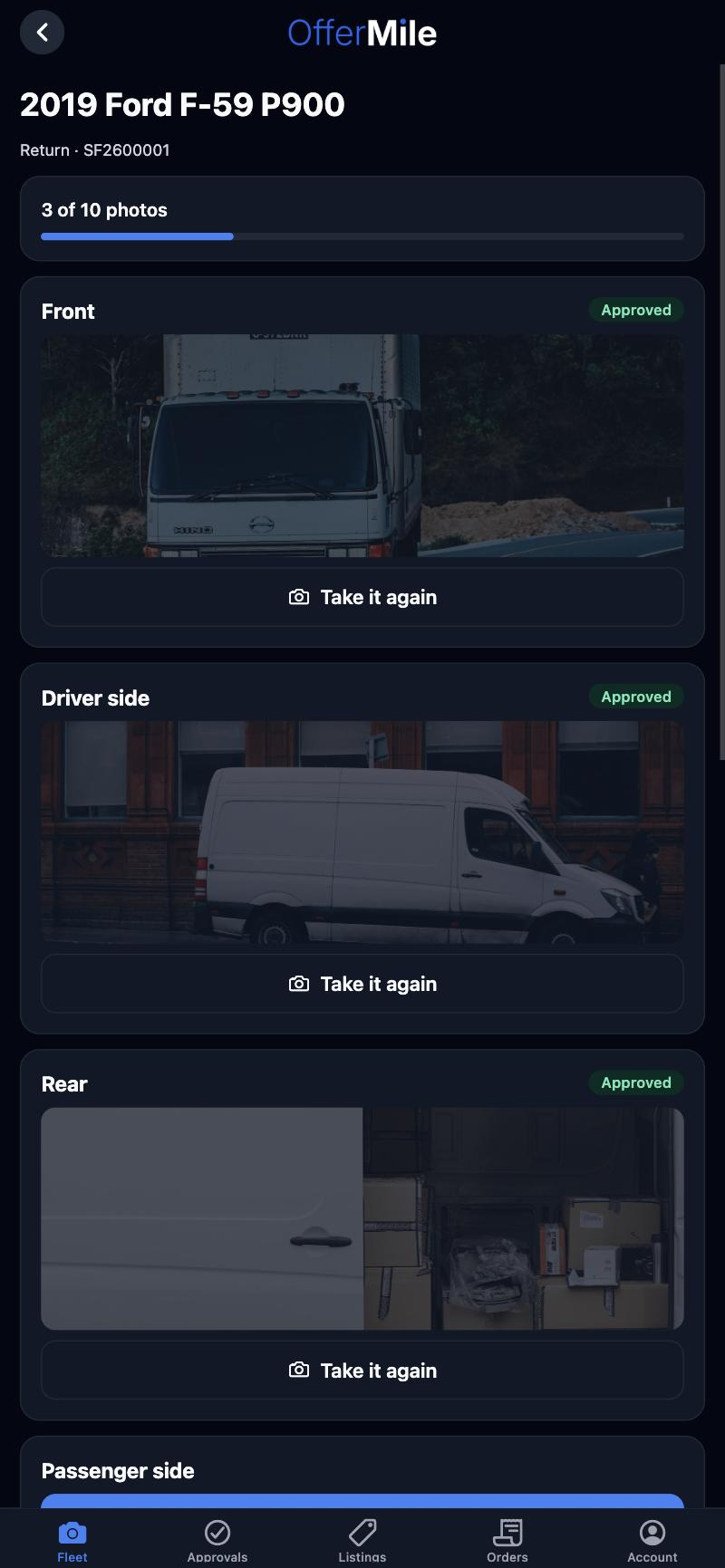
2019 Ford F-59 P900
Atlanta, GA · 97,400 mi · 1 left
$355/wk
Every last-mile company runs the same errands, alone, against the clock.
You need three more for six weeks. Renting from a national fleet costs a fortune and takes a month. The company across town has four parked.
You need drivers who can start Monday, already screened, with a clean MVR. Posting on a job board gets you fifty CVs and two who show up.
A van goes down Friday at 4pm. You call four shops. Three do not answer and the fourth quotes blind.
Insurance, scanners, shelving, routing software, a yard with space. Each one is its own hunt, its own vendor, its own invoice.
Search by role, license, area and availability, or just type what you need. Every candidate is screened, and you only pay when you approve one.
From other operators near you. Signed agreement, insurance verified, walk-around inspection at pickup, deposit held and returned.
Maintenance, insurance, equipment, robotics, software, yards and financing, from providers we approve category by category.
List the vans you are not using, the space in your yard, the hours of your mechanic. Listing is free; the commission comes off only what you actually earn.
Company details, W-9 and your insurance certificate. We verify it once.
In filters or in plain words: "a step van in Atlanta for peak", "a driver for Monday".
You pay exactly what the listing says. No buyer fee — the commission comes off the seller.
Invoices, signed agreements, condition reports with photos, claims and reviews. All of it, in one place.
Three vans parked behind the building for six weeks is not zero — it is what somebody two ZIP codes away is about to pay a national fleet triple for. The same goes for the space in your yard and the hours your mechanic is not using.
We bought the fourth van for peak and it sits nine months a year. Now it pays for itself renting to the ISP across town, and I still have it when I need it.
— the reason this marketplace exists
2021 Ford F-59 P1000
6 weeks
$2,700
2020 Isuzu NPR-HD P700
4 weeks
$1,560
Yard space · 4 van spots
2 months
$900
Already net of the platform commission. Listing cost nothing.
The argument at the end of a rental is always the same one: was that dent there before? This is built so nobody has to remember.
One photo per angle — front, each side, rear, dashboard, odometer, cab, cargo, tyres. The camera opens by itself at each step and it will not close with an angle missing.
At handover, at every maintenance visit and at the return. Every photo is stored with its angle, so the driver side of today sits next to the driver side of the day it left.
The owner sets how often the van needs it — every so many days, so many miles, or whichever comes first. When it comes due both companies are told, once. What was done lives on the rental, with the photos, where both of them can see it.
Anyone can type a VIN and a DOT number into a form. Here they get checked against the source before the listing goes live — and they keep being checked afterwards.
Year, make, model, engine and weight come out of the VIN itself, not out of what somebody typed. A van that is not what the listing says it is does not get that far.
Checked by VIN against the federal database. You find out before you rent it, not when the letter arrives.
USDOT number, operating authority and safety record, pulled from the federal register — not from a field the company filled in.
The certificate is read, approved and dated. When it expires the van comes off the marketplace and open rentals are flagged. Nobody has to remember.
Expired, and the listing pauses itself. The same for the registration.
Legal name, EIN, documents and operating network, reviewed by a person before the first deal. Owners stay anonymous to renters until they approve a request.
Selling a part does not end when someone buys it: it ends when it arrives. That part — the label, the carrier, the tracking number — lives inside the platform, not in another tab.
You accept the order and the label is already there, built from the weight and dimensions you entered when you listed it, ready to print. No other site, no address copied by hand.
USPS, UPS, FedEx, DHL and the rest, compared for that package and that destination. There is no single carrier: each shipment goes with whoever makes sense that time.
The number and the status show up on the order, for the seller and for the buyer, with nobody having to ask or forward an email. When it arrives, it marks itself.
When you list, you choose: a flat cost, free — you absorb it — or whatever it comes to by weight and destination. If someone buys several of your things, they ship together and it is calculated once.
A van does not fit in a box. That is what in-person delivery and pickup are for: no shipping is charged and the date is arranged right here, in the order messages.
If you already have an account with FedEx, UPS or anyone else, with your negotiated rates, we integrate it and labels go out with your numbers and your price. Nothing you already have set up needs to change.
Walk around the van, decide on a driver and answer an order standing where the work is.
If you run a last-mile company
The two things that cannot wait — the van and the hire — done where they happen.
The app is on its way to the App Store and Google Play. Everything you see here already works on the web.
A dozen places where the platform reads, writes or compares something so you do not have to. None of them decides anything on its own — every one ends with a person.
«Step van under $500 a week within 30 miles of 30297.» In plain words, in either language. It turns that into the filters and shows you what is actually there.
A driver answers when they can, not when somebody is free to take the call — by typing or by talking, whichever they prefer. Everyone is asked and scored the same way, and the summary is waiting on your screen in the morning.
Every candidate comes with a score and the reasons behind it — the license, the distance, the availability, the history. Not a number you have to take on faith.
Say the role, the station and the shift and you get a job posting to edit. On the other side, a person is told what is missing from their profile before a company ever sees it.
The handover photos against today's, the driver side against the driver side. It flags what changed and says how sure it is. What that costs, if anything, a person decides.
«How much did my vans earn this month?» «What do I have to do today?» It answers from your own data and sees nothing of anybody else's.
None of this charges anybody, rejects anybody or closes a deal on its own. It reads, it drafts and it flags — the decision is always somebody's, and it says so on screen every time.
Every screen, every email, every contract and every one of these answers, on the web and on the phone alike. The postings and listings companies write, too: if one went up in English, someone reading in Spanish reads it in Spanish, with the screen saying it is a translation. Not a translated front page with the rest in English: a test refuses to ship the platform if a single phrase is left untranslated. The person picks their language and everything follows.
A marketplace is worth exactly what is inside it. The first companies that list a van, answer a request or rate a provider are the ones who make it worth using for everyone who comes later — and today, on every other platform, they get nothing for it.
No other marketplace pays you for buying on it. Or for selling on it. Or for turning up and doing your part. That is not an oversight on their side — it is the difference on ours.
Community Credits with a fixed value — 100 credits = $1 — earned by taking part, never bought. They start adding up the day you open the account, and you spend them here or cash them out with your weekly deposit.
A fixed share of the year's profit goes into the Community Pool and is split by those points. No profit, no pool — said here and not in the small print.
Bringing somebody in counts, whoever you are: a company, a supplier or a driver. There is no payment per head: you get a share of the commission that person generates, while they generate it, through their first year. If they never trade, you earn nothing — and that is how it should be.
Credits and points cannot be bought, sold or transferred, and nobody ever pays to take part. Credits are not money out of our pocket either — they come out of what the platform actually earns. The rules are published, they only move forward, and what you have already earned cannot be reduced later.
Opening an account is free, and listing is free. When you buy, you pay exactly the listed price — there is no buyer fee. The platform takes 12% from the seller side, only on money that actually changes hands.
The renter must have their own commercial auto policy, with your company named as additional insured and loss payee, and we verify the certificate before pickup. A rental cannot start without it.
The handover and return are both photographed. You open a claim from the rental, the other company has a window to accept or dispute it, and what is awarded comes out of the deposit first. A disputed claim is decided by us with both sets of photos in front of us.
No. Most companies arrive for one thing — usually vans or drivers — and find the rest later. Nothing is bundled.
Opening an account takes a few minutes and shows you the real inventory in your area. Nothing to pay until you order something.